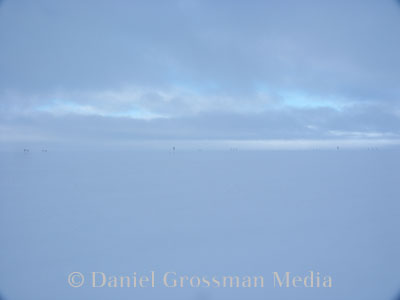

North Grip Drill Site, Greenland
Climate researchers need records from deep into Earth’s history in order to understand how the climate works and to predict how it might change in the future. Systematic weather records using instruments such as thermometers and rain gauges didn’t begin until the mid-19th century. But scientists say there are aspects of climate that don’t happen in such a short span of time. The most prominent aspect of Earth’s climate is the cycle of ice ages, which occur about once every hundred thousand years. During ice ages, Earth’s average temperature descends 10-20 degrees Fahrenheit and huge ice sheets cover much of the Northern Hemisphere. Many researchers say better information about this cycle of cooling and warming is critical for predicting how Earth may respond in the future to greenhouse gasses produced by the burning of fossil fuels.
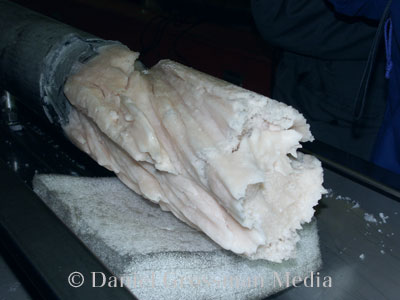
Ice drilled with augers from glaciers are one important source of information about the past climate of the Earth. The ice is cut from the surface down, as the instrument gradually penetrates to the bottom of the glacier. The ice is removed as cylinders, or cores, that are taken back to laboratories, stored in freezers and studied. Ice nearest the surface shows visible layers that can be counted like tree rings. Deeper ice is compressed by the tremendous pressure of the upper layers and does not have visible layers. Trapped within the ice are bubbles of air, tiny samples of the atmosphere when the ice was formed. Scientists melt bits of ice from different depths of a glacier to chart how the atmosphere has changed with time. They have learned how to estimate the temperature of the Earth’s surface when ice was formed. They also use ice sampled from cores to learn about precipitation—by looking at the thickness of layers—drought—by looking at how much dust is in the ice—and about volcanic activity—by measuring volcanic ash.
The world’s longest cores have been drilled in the oldest and largest ice sheets, in Greenland and Antarctica. Two deep cores were drilled in Greenland in the early 1900s. The cores revealed the startling finding that Earth sometimes undergoes dramatic climate swings of ten or more degrees Fahrenheit in a period of just several years, possibly in a single year. These changes, nicknamed “abrupt” changes, show that Earth’s climate may be less stable than once thought. Such abrupt change occurred during the last ice age and during the transition to the warm period in which we now live. However earlier cores from Greenland didn’t contain any information about times before the last ice age. Scientists want to know if similar abrupt changes occur when the Earth enters an ice age, because today we are on the verge of entering a new ice age (although global warming may prevent that). They say that if the Earth’s climate is as fickle during this transition period as it was during the last ice age, we may be in for some dramatic weather shifts. The North GRIP ice core, a new core a European team has been drilling since 1996 may show scientists whether we should be worried or not.
- Read Dan’s article in the New York Times on ice core drilling at North GRIP
- Visit Land of Ice and Snow Dan’s micro website on climate research in Greenland
Related Links
North Grip Drill Site, Greenland
- Listen to Climate of Uncertainty, Dan’s documentary (which contains material recorded at the North GRIP site) about abrupt climate change
- Listen to the segment of Dan’s documentary Climate of Uncertainty that was recorded in Greenland
- Listen to a podcast produced for National Geographic about Swiss Camp, another research site in Greenland
PHOTO GALLERY OF NORTH GRIP DRILL SITE, GREENLAND
- View Dan's Photographs of NORTH GRIP DRILL SITE, GREENLAND